


What the 2026 NDIS pricing schedule actually changed
The NDIS Pricing Schedule 2026–27 replaced the Pricing Arrangements and Price Limits (PAPL) document on 1 July 2026, making it the official reference for every price-controlled support from that date forward. The name change is not cosmetic. The new document is price tables only, grouped by provider type, with operational claiming rules pulled out entirely. Until the NDIA releases an updated Support Catalogue and claiming rules document, providers should keep the 2025–26 guidance on hand.
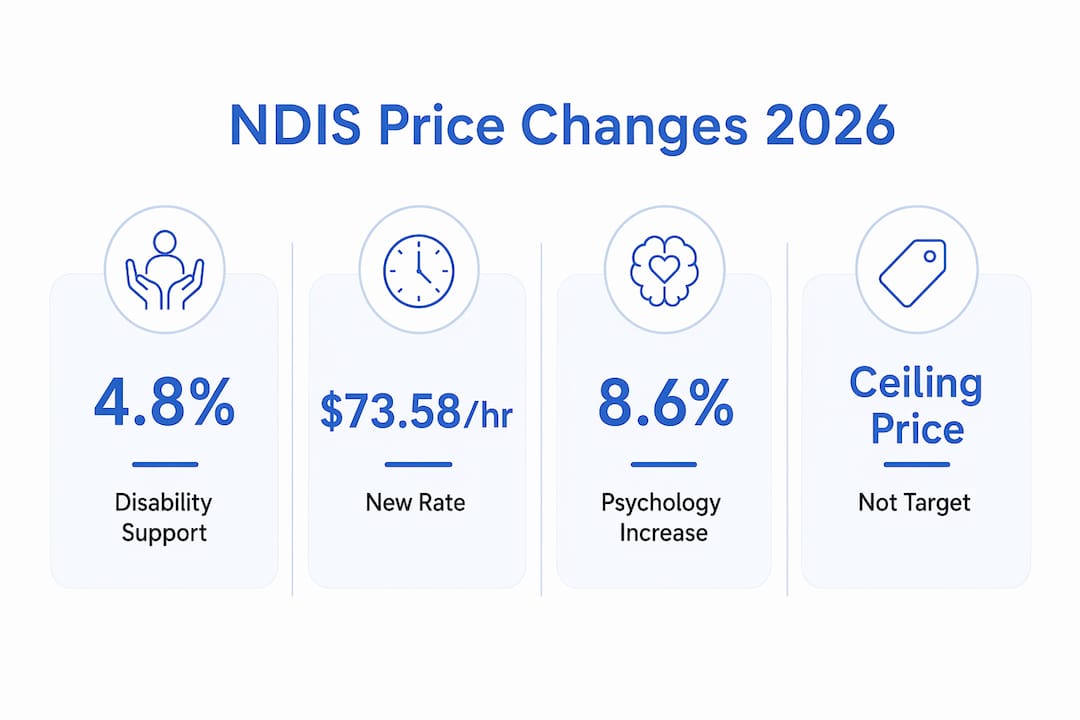
The headline moves: disability support workers gained 4.8% to $73.58/hr (up from $70.23/hr), psychology jumped 8.6% to $252.99/hr, and nursing rose roughly 3.6% to $128.05/hr for a registered nurse on a standard weekday. On the other side, dietetics dropped to $178.99/hr and exercise physiology to $161.99/hr, both cut to align with Medicare Benefits Schedule benchmarks. The “Other Professionals” category fell 19.5% to $156.16/hr. Support coordination and plan management fees stayed frozen.
Every price in the schedule is a ceiling, not a target. Providers can always charge less; they cannot charge more for price-controlled supports funded from NDIA-managed or plan-managed budgets.
| Support | 2025–26 rate | 2026–27 rate | Change |
|---|---|---|---|
| Disability support worker (weekday day) | $70.23/hr | $73.58/hr | +4.8% |
| Psychology | $252.99/hr | $252.99/hr | +8.6% |
| Registered nurse (weekday day) | $128.05/hr | $128.05/hr | +3.6% |
| Dietetics | $178.99/hr | $178.99/hr | — |
| Exercise physiology | $161.99/hr | $161.99/hr | — |
| Other Professionals | $193.99/hr | $156.16/hr | −19.5% |
| Plan management (monthly fee) | $104.45 | $104.45 | Frozen |
| Support coordination | — | Unchanged | Frozen |

How the 2026 NDIS pricing schedule is structured
The shift from PAPL to the Pricing Schedule is more than a rebranding. The old document bundled price tables with operational rules, worked examples, and claiming guidance. The new schedule strips that back to price tables alone, organized by provider type so you can locate your support items without reading the whole document.
A few structural provisions carry real compliance weight:
- Providers cannot apply new price limits to an existing service agreement without explicit participant agreement first. Charging higher rates without that consent breaches compliance and risks delayed payment.
- The schedule does not include claiming rules or an updated Support Catalogue. Both remain pending as of the schedule’s release on 22 June 2026.
- Short Term Accommodation (STA) bundled daily rates ended on 30 June 2026. Support is now claimed hourly by time of day, with accommodation claimed separately.
- The establishment fee for personal care and participation rose to $735.80, up from $702.30.
The schedule also sits against the backdrop of the National Disability Insurance Scheme Amendment (Securing the NDIS for Future Generations) Bill 2026, introduced into Parliament on 14 May 2026. If passed, the Bill would give the Minister for the NDIS the power to make pricing determinations directly, with the NDIA providing advice. That would shift pricing authority away from the NDIA’s annual review process, so providers and participants should watch legislative developments closely.
Pro Tip: Keep the 2025–26 PAPL accessible until the NDIA publishes updated claiming rules. The new schedule tells you the price ceiling; the old document still explains how to claim correctly.
What the Annual Pricing Review says about 2026–27 prices
The Annual Pricing Review (APR) is the mechanism behind every number in the schedule. This year’s APR moved away from simple inflation indexing toward benchmarking against external health markets, specifically the Medicare Benefits Schedule (MBS) and private health insurance (PHI) data.
Key adjustments and their rationale:
- Support workers and SIL: Indexed to the SCHADS Award wage decision, producing the 4.8% lift.
- Psychology: Benchmarked against PHI 1 ($250.00), PHI 2 ($252.00), and MBS ($260.00) for a 60-minute session. The resulting national maximum of $252.99/hr lands squarely in that range.
- Nursing: Increased using an 80/20 weighting of the ABS Wage Price Index and Consumer Price Index, reflecting that labor costs dominate nursing delivery costs.
- Dietetics and exercise physiology: Cut because NDIS prices sat materially above MBS and PHI benchmarks. The APR treats that gap as a market distortion, not a quality premium.
- Orientation and Mobility Specialists (OMS): Given a dedicated line item at $156.16/hr after the NDIS Quality and Safeguards Commission recognized OMS registration in march 2025. Previously, OMS practitioners claimed under the broad “Other Professionals” category at $193.99/hr.
- Support coordination and plan management: Frozen at current levels. The plan management monthly fee stays at $104.45.
The biggest forward-looking signal in the APR: unregistered providers delivering social, community, and civic participation (SCCP) supports will face a 10% price reduction from 1 January 2027, with that lower limit then frozen indefinitely. Registered providers keep the full limit and future indexation. The certification process typically runs 8–12 months, so the window to register before the cut takes effect is tighter than it looks.
How pricing changes affect you depending on your plan management type
Price limits under the 2026 schedule apply to NDIA-managed and plan-managed budgets. Self-managed participants are not bound by the caps but can use the schedule as a reference for what constitutes reasonable value.
Practical implications by plan type:
- NDIA-managed: Your provider bills the NDIA directly and cannot exceed the schedule’s price limits. No action needed from you on billing, but you should confirm your provider has updated their service agreement before new rates apply.
- Plan-managed: Your plan manager pays providers on your behalf. The caps still apply. With the plan management monthly fee frozen at $104.45, that portion of your budget is stable for 2026–27.
- Self-managed: You pay providers directly and can negotiate rates. The schedule’s prices are a useful ceiling reference, but you have flexibility below them.
Tips for participants navigating the price changes:
- Ask your provider to show you the updated service agreement before signing anything.
- Check that any price increase is consistent with the schedule’s limits for your support type.
- If you use STA (respite), expect itemized invoices instead of a single daily rate. Your short term accommodation costs will now appear as separate line items for support hours, sleepover, and accommodation.
- Talk to your support coordinator or plan manager if an invoice looks different from previous months.
- Budget reviews may be worth requesting if your supports include psychology, where the 8.6% increase is the largest single jump in the schedule.
Assistive technology and SDA pricing under the 2026 schedule
Assistive technology (AT) and Specialist Disability Accommodation (SDA) sit outside the standard hourly rate framework and carry their own pricing logic.
For AT, the schedule does not set a single hourly rate. Participants draw on their AT budget to purchase approved products from registered providers. Real-world pricing varies widely: NDIS AT products like the GoTalk Connect AAC device are listed at $1,395, while the Harmonie Health Hub starts from $997. Budgeting for AT requires checking current product prices against your plan’s AT allocation, not the hourly rate tables.
STA pricing changed structurally on 1 July 2026:
| STA component | 2026–27 rate (national) |
|---|---|
| Participant accommodation (per day) | $156.16 |
| Support worker accommodation (per day) | $156.16 |
| Support hours (weekday daytime) | $73.58/hr |
| Support hours (Saturday) | — |
| Support hours (Sunday) | — |
| Sleepover | — |
Providers must now rebuild STA quotes from itemized components rather than a single bundled day rate. Participants should expect invoices that list each component separately. If your provider is still issuing a single daily figure after 1 July 2026, that is a billing error worth flagging immediately.
SDA pricing rules remain separate from the standard schedule and are governed by the SDA Pricing and Payments Framework. Participants in SDA arrangements should confirm with their SDA provider that accommodation contributions are calculated under the current framework, not the STA accommodation rate.
How Onyxcare applies the 2026 pricing updates in practice
Onyxcare delivers NDIS disability support services including personal care, respite care, community nursing, supported independent living, and group activities, with 24/7 availability across its service area. The disability support worker rate increase directly affects the cost of these services, and Onyxcare’s approach to implementing it reflects what the NDIA’s own guidance requires: participant agreement before any service agreement is updated.
For participants receiving personal care or SIL supports from Onyxcare, the weekday daytime rate moves to the national standard ceiling rate. Onyxcare’s actual charge depends on the specific support, time of day, and any applicable loadings. The establishment fee for new personal care arrangements increased accordingly.
Onyxcare’s nursing team, which delivers community nursing under Schedule 3 of the pricing schedule, works within the updated enrolled and registered nurse rate tables. A registered nurse weekday daytime rate increased accordingly nationally. For participants with complex health needs, that nursing capacity is available around the clock, which matters when a health event does not wait for business hours.
For participants using Onyxcare’s community participation supports, the SCCP pricing for registered providers remains unchanged for the year ahead. The 10% cut from january 2027 applies only to unregistered providers, so registered providers like Onyxcare maintain the full rate and future indexation.
Pro Tip: When reviewing your service agreement with any provider, ask specifically which line item numbers from the 2026 Pricing Schedule apply to each support. That cross-reference is the fastest way to verify billing accuracy.
Key Takeaways
The 2026 NDIS Pricing Schedule sets updated maximum rates effective 1 July 2026, including increases for disability support workers and psychology, and reductions for several therapy categories to better align with Medicare benchmarks.
| Point | Details |
|---|---|
| New document, new structure | The Pricing Schedule replaces the PAPL from 1 july 2026, containing price tables only with no operational claiming rules. |
| Participant agreement required | Providers cannot charge new rates under existing service agreements without explicit participant consent first. |
| STA billing restructured | Bundled daily STA rates ended 30 june 2026; invoices now itemize support hours, sleepover, and accommodation separately. |
| Unregistered SCCP providers face cuts | A 10% price reduction for unregistered community participation providers takes effect 1 january 2027, then freezes permanently. |
| Plan management fees stable | The monthly plan management fee remains unchanged from 2025–26. |