


What is an NDIS sleepover shift under 2026 rules?
An NDIS sleepover shift is a continuous eight-hour period overnight where a worker sleeps at a participant’s home and provides support only when needed. The worker is not awake throughout the night. That distinction matters practically: sleepover shifts are funded as a flat-rate allowance called Night-Time Sleepover Supports under the NDIS Pricing Arrangements and Price Limits (PAPL), not as hourly active care.
The flat rate covers up to two hours of active support within those eight hours. Think of it as a safety net, not a care schedule. If a participant needs help going to the bathroom at 2:00 AM, the worker assists and returns to sleep. That time counts toward the two-hour active support limit included in the flat rate.
Here is what the core rules look like in practice:
- Eight-hour span: The sleepover must be a continuous overnight period, beginning before midnight and ending after midnight.
- Up to two active hours included: The flat-rate Night-Time Sleepover Support covers up to two hours of active assistance within the shift.
- Beyond two hours: Providers may bill any additional active hours beyond the included two at the relevant hourly or penalty rates, according to the day and with documented service agreements.
- Not the same as active overnight support: Active overnight support funds participants who consistently need more than two hours of help per night. If a participant regularly hits that threshold, the provider should contact the NDIA to review the plan.
- Continuous shift counting: Any hours worked immediately before or after the sleepover are counted as one continuous shift for pay and rostering purposes.
Confusing sleepover shifts with hourly supports is one of the most common billing errors providers make. The NDIS Commission has flagged this repeatedly, and the consequences range from audit clawbacks to Fair Work compliance issues.
What are the WHS and provider obligations during a sleepover?
Providers carry the primary duty of care for worker safety during overnight shifts, and that obligation is specific, not general. Under Clause 25.7© of the SCHADS Award, workers must be provided with a separate room containing a bed and clean linen, access to food preparation areas and staff facilities where they exist, and free board and lodging for each night of the sleepover.

Safe Work Australia defines fatigue as mental or physical exhaustion that reduces the ability to work safely. Providers must actively manage that risk, especially for workers who hold multiple engagements across different clients or shifts.
Key obligations for providers and participants:
- NDIS Code of Conduct: Providers must maintain a working environment that is safe and free of health risks, as far as reasonably practicable.
- NDIS Practice Standards: Registered providers must demonstrate that WHS risks are identified and managed during sleepover shifts, and that the support environment is safe for both the participant and the worker.
- Participant obligations: NDIS participants who directly employ their own workers may be considered a Person Conducting a Business or Undertaking (PCBU) under state or territory WHS laws, carrying their own duty to provide a safe working environment.
- Disruption management: When a participant’s sleep patterns change or they begin waking frequently, providers must work with professionals such as an occupational therapist to assess whether active night supports are more appropriate.
- Behavior support needs: Where a participant has a Behavior Support Plan, workers follow its strategies during overnight disruptions. Without one, providers document behavioral changes and work with the support team to reduce risk.
- Documentation: Providers should record every active support episode during a sleepover shift. Accurate records protect against billing disputes and NDIS audits.
Pro Tip: Run a formal risk assessment before the first sleepover shift at any new participant’s home. SafeWork NSW publishes example checklists specifically for this purpose, covering fatigue, sleeping environment, and emergency access.
How do the June 2026 SCHADS Award changes affect sleepover shifts?
The Fair Work Commission issued a determination in April 2026 changing several sleepover provisions in the SCHADS Award, effective from the start of each employee’s first full pay period on or after June 1, 2026. The changes followed a Full Federal Court decision in Fair Work Ombudsman v Jats Joint Pty Ltd [2026] FCAFC 25, which confirmed that sleepovers are separate and distinct periods that do not form part of a shift.
That ruling had real consequences for how providers roster and pay workers. Here is what changed:
- Sleepovers are not active shift hours: The sleepover period itself does not count as ordinary hours worked. Only the hours before or after the sleepover count toward ordinary time.
- Penalties calculated separately: Shift penalty rates and loadings apply independently to the work periods on either side of a sleepover, not across the combined span.
- A sleepover can serve as a break: Under the new rules, a sleepover can count as a break between rostered work periods, which affects how back-to-back shifts are structured.
- Minimum rostered hours: Employees must be rostered or paid for a minimum of four hours of work before or after the sleepover period.
- Overtime during the sleepover: If a worker is woken to provide active support, the SCHADS Award requires payment at the prescribed overtime rate, with a minimum payment equivalent to one hour’s work. If that active work exceeds one hour, the overtime rate applies for the full duration.
- Fatigue protection: Providers must allow adequate rest between a sleepover and the next active shift, with a minimum ten-hour break between shifts required.
The practical upshot: rosters that treated sleepovers as rolling into the next morning shift without a proper break were non-compliant before June 2026 and remain so now. Providers need to review their rostering systems against the updated Award provisions.
How do top Australian NDIS providers compare for sleepover support?
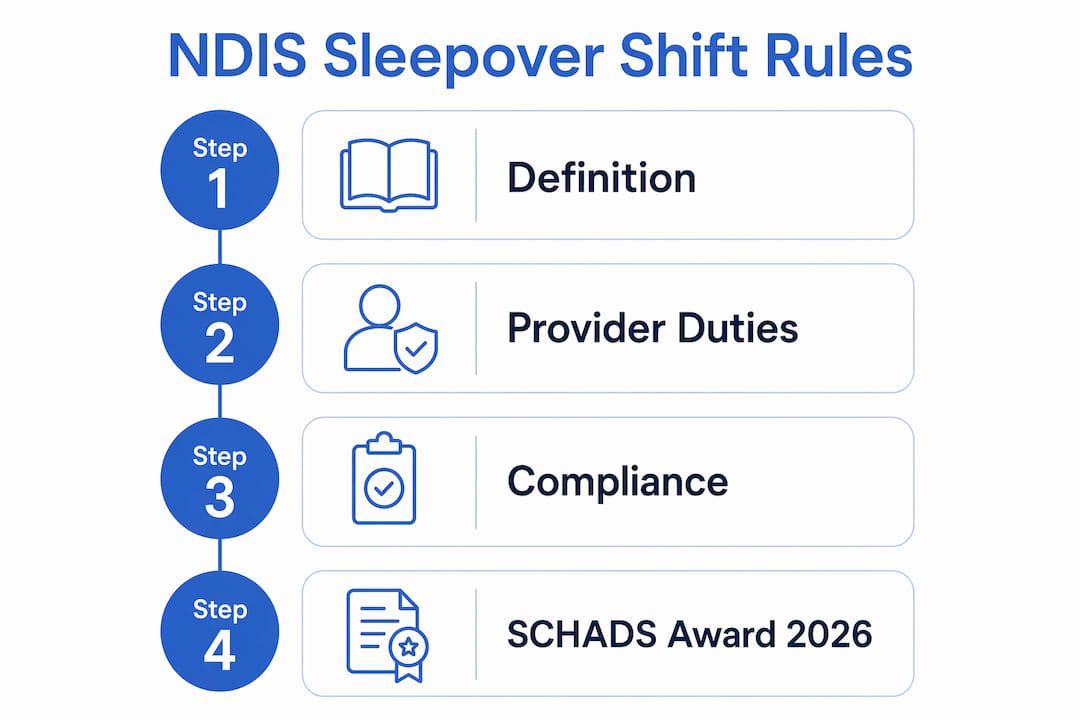
Four registered NDIS providers currently active in Australia offer services relevant to overnight and sleepover support. Their specializations and geographic reach differ considerably.
| Provider | Services Offered | Areas Served | Specializations | NDIS Registered | Rating |
|---|---|---|---|---|---|
| Dream Maker Community Services | SIL, SDA accommodation, community participation, household tasks, daily living skills, travel support | Sydney, Melbourne | SIL, SDA, youth disability support | Yes (since 2019) | 4.8★ (25 reviews) |
| Independent Disability Services | Domestic support, personal care, community access | Victoria | Individualized community access, personal support | Yes | 3.4★ (21 reviews) |
| Disability Support Project | Telehealth support coordination, functional capacity assessments, behavior support, SIL documentation, provider training | Nationwide (telehealth) | Clinical telehealth supports, NDIS provider training, SIL compliance | Yes | 3.8★ (12 reviews) |
| Onyx Care | Personal care, respite care, community nursing, SIL, short-term accommodation, community participation | Queensland | In-home and community NDIS supports, 24/7 availability | Yes | 5★ (1 review) |
Dream Maker Community Services stands out for participants seeking SIL or SDA accommodation in Sydney or Melbourne. Registered since 2019, it covers community participation, daily living skill development, and household tasks, with a particular focus on younger participants. Its track record in supported independent living makes it a practical choice for families arranging ongoing overnight support in those cities.
Independent Disability Services suits participants in Victoria who prioritize individualized domestic and personal support. Its positioning centers on helping people live as independently as possible, with community access as a core offering.
Disability Support Project operates differently from the others. It delivers clinical supports via telehealth Australia-wide, which means it is not a traditional in-home overnight provider. Its value is in support coordination, functional capacity assessments, and training for other providers navigating SIL Practice Standards compliance. Pricing is publicly listed: SIL Document Top-Up Pack from $1,000 plus GST, and SIL Workforce Training from $249 including GST.
Onyxcare serves participants in Queensland with personal care and respite delivered by qualified nurses and vetted support workers. Its 24/7 availability is the practical differentiator for families who need overnight support that can respond at any hour, not just during business hours.
How do you choose the right provider for NDIS sleepover support?
Selecting a provider for overnight care involves more than checking a registration number. The right fit depends on where you live, what the participant needs during the night, and how well the provider documents and bills sleepover shifts.
Work through these criteria before signing a service agreement:
- NDIS registration: Confirm the provider is registered with the NDIS Quality and Safeguards Commission. Registered providers are bound by the Practice Standards and Code of Conduct, which directly govern sleepover shift safety.
- SCHADS Award compliance: Ask how the provider rosters sleepover shifts and whether they apply the correct overtime rates when workers are woken for active support. Non-compliant rostering creates legal exposure for providers and service disruptions for participants.
- Experience with sleepover shifts specifically: General disability support experience is not the same as experience managing overnight shifts. Ask for examples of how they handle disruptions, behavior support needs, and fatigue management.
- Geographic access: Providers must physically reach the participant’s home. Telehealth-only providers like Disability Support Project cannot fill an in-home overnight role.
- Billing transparency: Understand exactly how the flat-rate Night-Time Sleepover Support is claimed and how additional active hours beyond two are invoiced. Misunderstanding this structure leads to billing errors and funding shortfalls.
- Service agreement clarity: The agreement should specify the sleepover span, what constitutes active support, how disruptions are recorded, and the process for escalating to active overnight support if needs change.
Pro Tip: Before finalizing a provider, ask them directly: “How do you document active support minutes during a sleepover shift?” A provider with a clear, practiced answer has done this before. Vague responses are a warning sign.
For participants whose overnight needs are increasing, contact the NDIA before the plan runs short. Shifting from a sleepover model to active overnight support requires a plan review, and starting that conversation early avoids gaps in care.
Onyxcare provides NDIS sleepover and overnight support in Queensland
Families searching for disability support services in Queensland that cover overnight and sleepover needs will find Onyxcare’s model built around exactly that kind of availability. Qualified nurses and vetted support workers are available around the clock, which means a sleepover shift does not end when the morning comes and neither does the relationship with the care team.
Onyxcare’s service range covers personal care, respite care, community nursing, supported independent living, short-term accommodation, and community participation. That breadth matters when a participant’s overnight needs are connected to daytime health management or community goals. The same team that supports a participant through the night can coordinate with community nursing for clinical continuity, rather than handing off to a separate provider each morning. For Queensland families navigating the 2026 SCHADS Award changes and looking for a provider that handles sleepover billing correctly, Onyxcare is worth a direct conversation.
Key Takeaways
A sleepover shift under the NDIS is a flat-rate, eight-hour overnight support period covering up to two active hours, governed by both the NDIS Pricing Arrangements and the SCHADS Award, with significant rule changes effective June 2026.
| Point | Details |
|---|---|
| Sleepover shift definition | A continuous eight-hour overnight period where a worker sleeps and provides up to two hours of active support. |
| Flat-rate billing structure | Night-Time Sleepover Supports cover up to two hours of active assistance within the eight-hour shift. If a worker provides more than two hours of active support, those additional hours are billed separately at applicable hourly or penalty rates, depending on the day. |
| June 2026 SCHADS changes | Sleepovers are now formally separate from active shift hours; a minimum four-hour work period before or after is required. |
| Provider selection criteria | Verify NDIS registration, SCHADS Award compliance, sleepover-specific experience, and billing transparency before signing. |
| Onyxcare | Queensland-based NDIS provider offering 24/7 personal care, respite, community nursing, and SIL with sleepover support available. |